

Introduction to CNC Machining
CNC machining (Computer Numerical Control machining) is one of the most widely used manufacturing processes in modern industry. It allows manufacturers to produce high-precision parts using computer-controlled machines.
From aerospace components to consumer electronics, CNC machining plays a critical role in producing complex and accurate parts at scale.
As global demand for precision manufacturing continues to grow, CNC machining has become a key solution for industries requiring high quality, consistency, and efficiency.

What Is CNC Machining?
CNC machining is a subtractive manufacturing process where material is removed from a solid block (called a workpiece) using computer-controlled cutting tools.
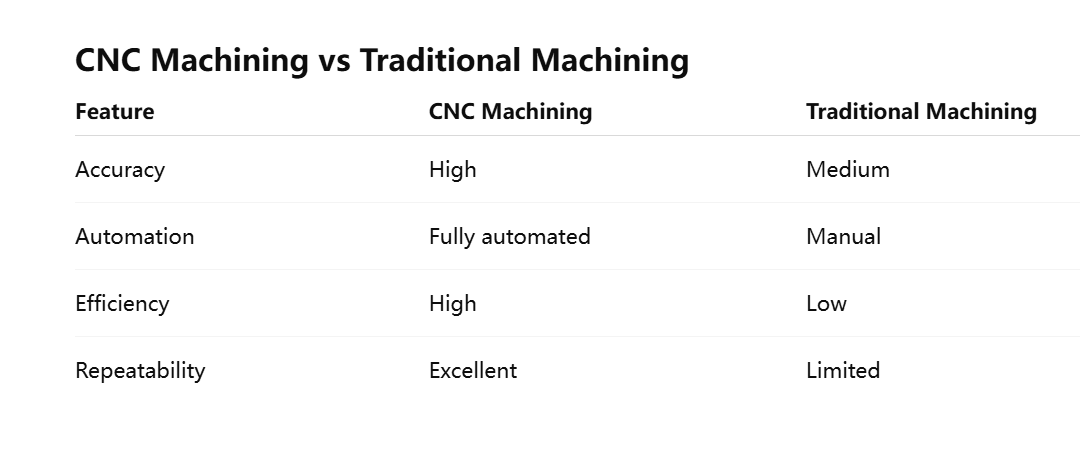
Unlike manual machining, CNC machines operate based on programmed instructions, ensuring consistent and repeatable results.
Key Characteristics:
- High precision and tight tolerances
- Automated and repeatable processes
- Suitable for complex geometries
- Compatible with various materials
How Does CNC Machining Work?
Step 1: CAD Design
The process begins with a CAD (Computer-Aided Design) model. Engineers create a digital 3D model of the part using design software.
Step 2: CAM Programming
The CAD file is converted into CAM (Computer-Aided Manufacturing) instructions. This generates toolpaths and machine commands (G-code).
Step 3: Machine Setup
The operator sets up the CNC machine, including:
- Selecting cutting tools
- Fixing the workpiece
- Configuring machine parameters
Step 4: Machining Process
The CNC machine follows programmed instructions to cut, drill, mill, or turn the material into the desired shape.
Step 5: Finishing and Inspection
After machining, parts may undergo surface finishing and quality inspection to ensure accuracy.
Types of CNC Machining Processes
CNC Milling
Rotating cutting tools remove material from the workpiece. Suitable for complex shapes.
CNC Turning
The workpiece rotates while a cutting tool shapes it. Ideal for cylindrical parts.
CNC Drilling
Creates precise holes in materials.
Multi-Axis Machining
Advanced machines (3-axis, 4-axis, 5-axis) allow for more complex geometries.
Materials Used in CNC Machining
CNC machining supports a wide range of materials:
Metals
- Aluminum
- Stainless steel
- Brass
- Titanium
Plastics
- ABS
- Nylon
- POM (Delrin)
- PC
Material selection depends on strength, cost, and application requirements.
Advantages of CNC Machining
1. High Precision
CNC machines can achieve tolerances as tight as ±0.01 mm.
2. Repeatability
Perfect for mass production with consistent quality.
3. Versatility
Supports various materials and complex designs.
4. Efficiency
Automated processes reduce labor costs and production time.
Applications of CNC Machining
CNC machining is widely used across industries:
- Automotive parts
- Aerospace components
- Medical devices
- Electronics enclosures
- Industrial equipment
Cost Factors in CNC Machining
Several factors affect CNC machining cost:
- Material type
- Part complexity
- Tolerance requirements
- Production volume
- Surface finishing
Understanding these helps buyers optimize cost.
Real-World Example
A startup developing a custom aluminum enclosure used CNC machining for prototyping.
Results:
- Prototype delivered in 5 days
- Design improved after testing
- Successfully moved to small batch production
Why Choose CNC Machining for Rapid Prototyping
CNC machining is ideal for rapid prototyping because: No need for molds
- Fast turnaround time
- High accuracy
Real material testing
Conclusion
CNC machining is a reliable, precise, and efficient manufacturing method suitable for both prototyping and mass production. Its flexibility and accuracy make it a preferred choice across industries.
Get CNC Machining Services
Looking for a reliable CNC machining supplier?
We offer:
Custom CNC machining services
- Rapid prototyping solutions
- Competitive pricing
- Strict quality control
- Contact us today for a fast quote and expert support.