
Introduction to Rapid Prototyping
Rapid prototyping has become a critical part of modern product development. In today’s competitive market, companies need to move from idea to product faster than ever before. Traditional manufacturing methods are often too slow and expensive for early-stage development, which is where rapid prototyping comes in.
Rapid prototyping allows designers, engineers, and businesses to quickly create physical models of their ideas. These prototypes can be used for testing, validation, design improvement, and even early-stage marketing.
As industries such as automotive, electronics, medical devices, and consumer products continue to evolve, rapid prototyping plays a key role in reducing development time and minimizing risks.
What Is Rapid Prototyping?
Rapid prototyping is the process of quickly creating a physical model or sample of a product design using advanced manufacturing technologies.
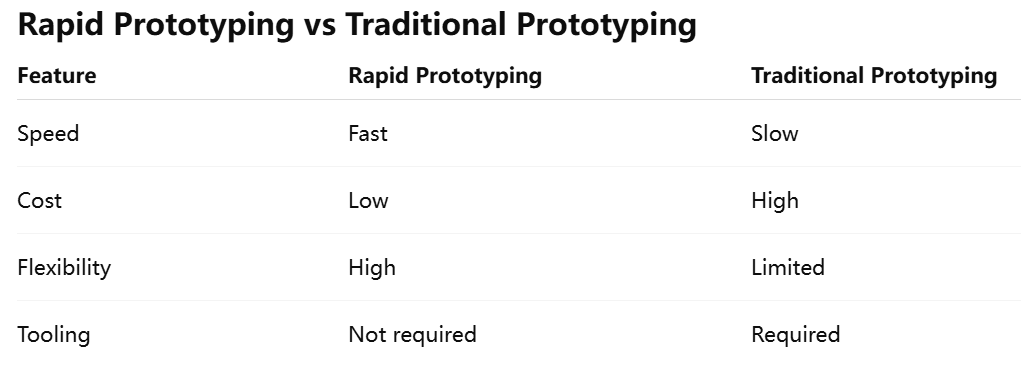
Unlike traditional prototyping methods, which can take weeks or months, rapid prototyping significantly reduces production time, often delivering parts within days.
Key Features of Rapid Prototyping
Fast turnaround time
- Low initial cost (no expensive tooling required)
- Design flexibility
- Ability to test real materials
- Suitable for low-volume production
- Rapid prototyping is widely used during the early stages of product development to validate design concepts before moving into full-scale production.
Why Rapid Prototyping Is Important
In modern manufacturing, speed and accuracy are everything. Rapid prototyping provides several strategic advantages:
1. Faster Product Development
Companies can quickly move from concept to physical product, reducing time-to-market.
2. Early Problem Detection
Design flaws can be identified and corrected before mass production.
3. Cost Reduction
Fixing issues during prototyping is much cheaper than fixing them during production.
4. Improved Communication
Physical prototypes help teams, clients, and stakeholders better understand the design.
Rapid Prototyping Process
Step 1: Concept Design
The process starts with an idea, which is translated into a digital design using CAD software.
Step 2: 3D Modeling
En
gineers create a detailed 3D model that defines dimensions, structure, and features.
Step 3: Prototyping Method Selection
Depending on requirements, a suitable manufacturing method is chosen, such as CNC machining or 3D printing.
Step 4: Prototype Manufacturing
The physical prototype is produced using selected materials and processes.
Step 5: Testing and Evaluation
The prototype is tested for functionality, durability, and design accuracy.
Step 6: Design Optimization
Based on feedback, the design is refined and improved.
Types of Rapid Prototyping Technologies
1. CNC Machining
A subtractive manufacturing process that removes material to create precise parts. Ideal for functional prototypes.
2. 3D Printing (Additive Manufacturing)
Builds parts layer by layer. Suitable for complex geometries and quick visual models.
3. Vacuum Casting
Uses silicone molds to produce small batches of plastic parts.
4. Injection Molding (Rapid Tooling)
Used for low-volume production with faster and cheaper tooling.
5. Sheet Metal Fabrication
Used for metal enclosures and structural components.
Materials Used in Rapid Prototyping
Material selection depends on application and performance requirements.
Common Materials Include:
- Metals
- Aluminum
- Stainless steel
- Brass
- Plastics
- ABS
- Nylon
- Polycarbonate
- Elastomers
- Silicone
- Rubber
Using real production materials allows for accurate functional testing.
Types of Prototypes
Low-Fidelity Prototypes
Simple models used for concept validation and visualization.
High-Fidelity Prototypes
Highly detailed and functional models that closely resemble final products.
Applications of Rapid Prototyping
Rapid p
rototyping is used across various industries:
Product Development
Testing new product designs before production.
Automotive Industry
Developing and testing vehicle components.
Medical Industry
Creating prototypes for medical devices and equipment.
Consumer Electronics
Designing and testing electronic products.
Benefits of Rapid Prototyping
1. Reduced Time-to-Market
Faster development cycles give companies a competitive advantage.
2. Lower Development Costs
Eliminates the need for expensive molds in early stages.
3. Design Flexibility
Easy to modify and improve designs.
4. Improved Product Quality
Continuous testing leads to better final products.
5. Better Risk Management
Reduces the risk of costly production errors.
Real-World Case Study
A startup developing a smart home device used rapid prototyping to test multiple design iterations.
Results:
- Prototype completed in 3 days
- 3 design improvements identified
- Reduced final production defects by 40%
This shows how rapid prototyping accelerates innovation and improves product quality.
When to Use Rapid Prototyping
Rapid prototyping is ideal for:
- New product development
- Design validation
- Low-volume production
- Market testing
Future Trends in Rapid Prototyping
The rapid prototyping industry continues to evolve with new technologies:
- Advanced 3D printing materials
- AI-driven design optimization
- Faster CNC machining systems
Hybrid manufacturing processes
Conclusion
Rapid prototyping is a powerful tool for modern product development. It allows companies to innovate faster, reduce risks, and bring high-quality products to market efficiently.
As competition increases across industries, businesses that adopt rapid prototyping gain a significant advantage in speed, cost, and product quality.
Get Rapid Prototyping Services
Looking for a reliable rapid prototyping partner?
We provide:
- CNC machining and 3D printing services
- Low-volume manufacturing solutions
- Fast turnaround times
- High-quality materials and finishing
👉 Contact us today for a fast quote and professional support.